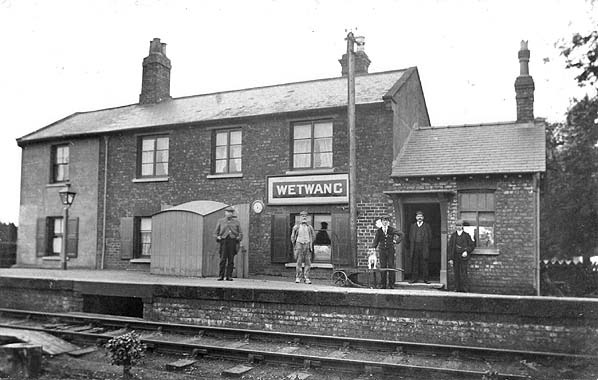
1. Wetwang
Any list of funny place names in Yorkshire has to start with the motherlode of them all: Wetwang.
Stop that sniggering at the back there! This is a quaint Yorkshire village with none of the smuttiness that its odd name might suggest. There are two theories about the origin of the name. The first argues that “Wetwang” comes from the Old Norse “vaett-vangr“, which means “field for the trial of a legal action”. The other (rather less exciting) one argues that it means “wet field”.
2. Huttons Ambo
The toponym “Hutton” derives from the Old English words “hōh tūn“, meaning settlement on/by the hill ridge. The suffix “ambo” is Latin, meaning “both”: the modern village was formed by joining two Huttons, High Hutton and Low Hutton, together. The land at Low Hutton was known as Hutton Colswayn, while the land around High Hutton was known variously as Hutton Mynchon and Hutton Bardolf.
3. Thwing
The name of this tiny village in the East Riding of Yorkshire either derives from the Old Scandinavian “thvengr” or the Old English “thweng” – both meaning a narrow strip, or narrow strip of ground.
4. Blubberhouses
The name of this village near Harrogate comes from the Anglo-Saxon “Bluberhūs”/”Bluberhūsum”, meaning “the houses near the bubbling stream” – possibly a reference to the nearby River Warburn. At various points during history, Blubberhouses has been recorded as “Bluburgh”, “Bluborrow”, “Bluburhouse”.
5. Crackpot
The name “Crackpot” has Scandinavian origins and may go back to the Viking settlement of the Swaledale where it is located. The element “Crack” comes from the Old English “kraka“, meaning “crow”, while “pot” is a Scandinavian word meaning a deep hole or pit. This may refer to the many caves which can be found in the locality.
6. Kirkby Overblow
The prefix “Kirkby” is common in Yorkshire and means “settlement by/around a church”. “Overblow” is believed to be a corruption of “oreblow“: a reference to the village’s iron smelting past.
7. Thornton-Le-Beans
Thornton – also a common place name in this North Yorkshire locality – means a settlement by the thorn bushes.
The name of this settlement went through a number of iterations before arriving at its current form. In the Domesday Book, it was recorded as Gristorentun – “griss” being an Old Norse nickname for a pig. By the 13th century, the pig reference had been dropped in favour of Latin and the settlement was being called “Thornton-in-Vivario” (“Vivario” was a Latin word denoting some kind of animal enclosure, like a game park or fishpond.)
Moving onwards to 1534 and the settlement was recorded as Thornton-in-Fabis, “fabis” being the Latin for “(horse) beans”. In other words, a farm was located here that grew beans – possibly for animal feed purposes. The modern, French-infused name featuring “le” was adopted in the 16th century.
Fun fact: Thornton-Le-Beans has gained a prominent fan in the American author Bill Bryson, who wrote in his popular book “Notes From A Small Island” that he wished to be buried in the village due to its perfectly quirky name.
8. Giggleswick
Rather disappointingly, this village did not get its name because it was a place of great, unceasing mirth. Rather, it stems from Old Norse, translating as “Gikel’s farm/dairy farm/settlement” (“wick” or “wic” was an Old Norse/Old English word for a (dairy) farm/settlement). It was recorded in the Domesday Book as “Ghigeleswic“.
9. Upperthong
The name Upperthong has similar origins to Thwing; the “thong” ending comes from thvengr or thweng, meaning a narrow strip (of land). “Upper” came from the Scandinavian “uffera“, which means “upper”/”higher”/”uppermost”. So, “Upperthong” was a strip of land which was located a little higher than the surroundings.
10. Fryup
I’m guessing there are some greasy spoon cafés there these days, cheerfully cashing in on the name – but Fryup’s colourful name is actually geographical in nature. “Fry-” may have come from the Old Norse female name “Frigg“, who was a goddess and the wife of Odin. “Up” derived from the Old English word “hop“, meaning a small valley. So, “Fryup” was “Frigg’s valley”.
11. Booze
Because it’s England, then I’m sure there’s a pub there, and the locals are seriously missing a trick if they aren’t calling it the “Booze Boozer”.
Joking aside, the first record of Booze was in 1473, when it was called “Bowehous“. This comes from the Old English words “boga” (=bow/curve) and “hus” (=house), possibly meaning a house on the curve of a hill.
12. Wigtwizzle
I love this one, it sounds like you might be casting a magic spell when you say it! However, the name “Wigtwizzle” derives from the descriptive name “Wicga’s land at the confluence of two streams”.
13. Bedlam
Happily, this has nothing to do with the Hospital of St. Mary in Bethlehem, or “Bethlem” for short, the place which give rise to the English colloquial word describing “a place of uproar, chaos or confusion”.
Bedlam, North Yorkshire, is far more peaceful and the name comes from the Old English/Old Norse word “botlum“, meaning “by the buildings”.
14. Boggle Hole
A picturesque little cove just south of Robin Hood’s Bay, Boggle Hole is beloved of daytrippers who love the pretty beach walks, fossil hunting opportunities and endless marine rock pools. Back in the 17th and 18th centuries, smugglers took advantage of the hidden location to conceal their contraband.
The funny name refers to the coastal cave which was thought to be inhabited by a kind of imp or hobgoblin, the “boggle”. Locals, believing that these little spirits possessed healing powers, took sick children to the cave in the hope of gaining relief from their ailments.
Fun fact: The name “boggle” stems from the Old English word “bugge“, meaning a monster, scarecrow, or hobgoblin. “Bugge” is thought to be the root of the modern words “bogeyman” and “bugbear”.
—–
Other articles for fans of funny words, Yorkshire, and funny Yorkshire words!
Err nerr! 18 Hull dialect words
Yorkshire words and phrases I’m still using after 19 years abroad
The Battle of Flamborough Head – American history in Yorkshire
Going back to Britain – the joys and the frustrations
—–
Image credit: John Alsop Collection